Data Centers: Health Costs and Political Risk Drive Midterm Conflicts
New research links hyperscale facilities to air pollution and noise, complicating races in red states where most new capacity is planned.
By Lauren Bello ·
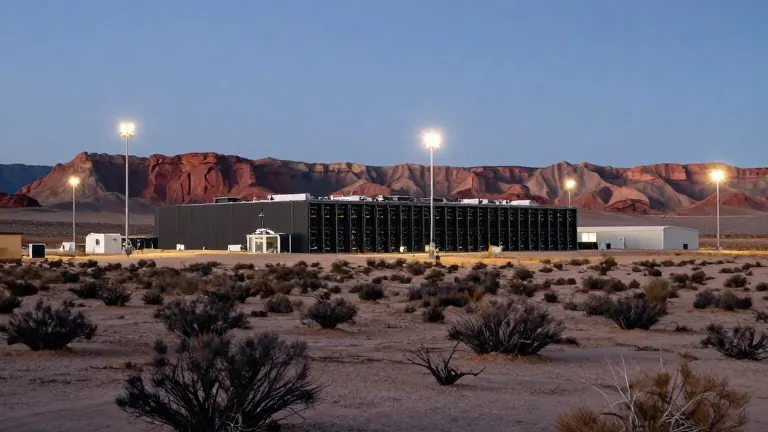
The rapid expansion of hyperscale data centers has shifted from a pure economic opportunity to a central issue in the November 3 midterms, as emerging health data complicates the political calculus for candidates in key districts. In Page, Arizona, residents are mobilizing against a proposed $10 billion facility, mirroring a national trend where local opposition is challenging state and federal support for the infrastructure that powers artificial intelligence.
Researchers at the University of California-Riverside project that emissions from these facilities could contribute to nearly 1,300 deaths annually by 2030. Their modeling estimates an annual public health burden exceeding $20 billion in 2028, driven by air pollution linked to heart conditions, respiratory issues, and elevated cancer risks. These centers rely on backup gas generators during peak demand, a factor that drives much of the local concern over environmental impact.
The political stakes are highest in states President Donald Trump won in 2024, where most new capacity is proposed. According to market intelligence firm Cleanview, 60% of data center capacity under construction is located in states where the president won by at least five percentage points. Excluding Virginia, 92% of this capacity is in states the president carried, placing Republican candidates in a difficult position between party loyalty and local voter sentiment.
In Ohio, the issue has become a flashpoint in the U.S. Senate race. Democratic former Senator Sherrod Brown is attacking incumbent Republican Jon Husted, labeling him "the face of data centers" in advertising. Ohio has approved roughly $2.5 billion in state and local tax breaks over the last decade, attracting dozens of facilities from major tech companies. More than a dozen local referendums on data centers will appear on ballots in the state, the most of any state.
Husted has pushed back by framing the issue as a local decision. In a statement, his spokesperson Tom Evans said the senator believes data centers should remain under local control but that companies must pay for infrastructure costs like energy. A memo from the National Republican Senatorial Committee described the issue as "the anchor hanging around Husted's neck," signaling internal concern over the political liability.
Polling data reflects the growing skepticism. An October Washington Post-ABC News-Ipsos poll found that two in three Americans oppose new data center construction. In Arizona, 57% of registered voters opposed more large centers in an August poll by Noble Predictive Insights. In Ohio, 55% of adults opposed construction in an early-October survey by Ohio Northern University and SurveyUSA, with two-thirds citing negative environmental impacts.
The Data Center Coalition argues that regulations are sufficient. Dan Diorio, the group's executive vice president for state policy, cited a review of Virginia, the largest market, which found minimal use of backup power sources. "Data centers are committed to being responsible partners where they operate," Diorio said. Critics, however, point to noise levels exceeding 90 decibels and the use of "forever chemicals" in cooling systems as ongoing concerns that industry assurances do not fully address.
Local actions are already influencing leadership. In Page, voters replaced the mayor in July following the city council's approval of a land sale for the project. The development would occupy 500 acres near Horseshoe Bend, an area currently defined by blackbrush and native grasses. With about 1,400 data centers operating in the U.S. and over 2,000 more planned, the conflict between economic expansion and local health concerns will define voting patterns in competitive districts this week.
More Business · Watch Your Wallet · Report a business · Got a Story?