Culver City voters to decide if 16-year-olds can cast ballots in local elections
A charter amendment would allow teenagers to vote in city and school board contests, a move that narrowly failed in 2022.
By Mateo Thompson ·
Adult residents of Culver City will vote on November 3 to determine if 16- and 17-year-olds can cast ballots in municipal and school board elections. Measure YV seeks to amend the city charter to lower the voting age for these specific local contests. The proposal does not grant teenagers the right to vote in county, state, or federal races.
This is the second time the initiative has appeared on a ballot in the Westside city. A similar measure failed by 16 votes in 2022. That year, the proposal received 8,293 votes in support, surpassing the total for any single City Council candidate. In 2024, a citizens’ initiative to lower the voting age failed to gather enough signatures. In February of this year, the City Council voted 3 to 2 to place the measure on the November ballot at the request of the advocacy group Vote16 Culver City.
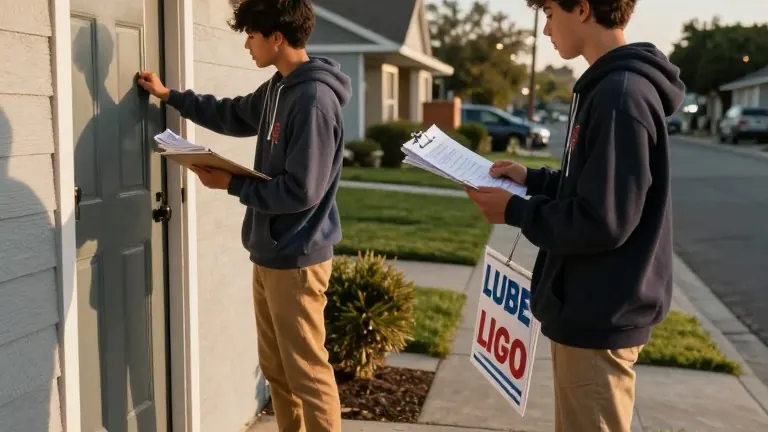
Arlo Meighan-Thiel, a 16-year-old junior at Culver City High School, leads the student group’s policy and advocacy efforts. He argues that teenagers are capable of making calm, educated decisions for local governance. Meighan-Thiel, who plays baseball, spends his free time canvassing neighborhoods to persuade residents to support the initiative. He notes that students attend school five days a week and should have a say in who represents them on the school board.
Supporters cite the fact that 16- and 17-year-olds in California can already work, drive, and pay taxes. They argue that these responsibilities indicate maturity sufficient for local voting. California has allowed pre-registration for these ages since 2016, automatically qualifying them to vote on their 18th birthday. Opponents counter that young voters may be too impressionable and vulnerable to manipulation by adults.
Five opponents, including City Council member Albert Vera and former Mayors Göran Eriksson and Ed Wolkowitz, wrote a statement for the voter guide. They argued that teen voters’ contact information would become part of the public record. This status would make them targets for political outreach from strangers. Vera and others believe the measure turns students into a captive voting bloc. Wolkowitz, who served on the City Council from 1994 to 2002, said the measure is unnecessary because a cut-off age is required, even if 18 is arbitrary.
Ron Bassilian, president of the political action committee Protect Culver City, said his organization would use legal channels to access voter data if the measure passes. He stated that the group would send flyers and cold-call new young voters, just as it would any adult. Bassilian, a Republican who ran for Congress in 2018, expressed concern that high schools would become arenas for political competition. He noted that while teenagers share personal information on social media, they rarely list home addresses, which would become public as voters.
Vice Mayor Bryan Fish supported the measure during the February City Council meeting. He told youth activists that they are the present, not just the future. Fish argued that city decisions on housing and climate change disproportionately affect young people. He said allowing them a seat at the table is the least the city can do. In California, Berkeley was the first municipality to drop the voting age to 16 for school board elections in 2016. Oakland followed in 2020, and Albany passed a broader municipal measure in 2024.