Minority candidates face steep odds in deeply partisan districts
Democratic nominee Lisa Kinney and Republican contender George Austin describe the financial and logistical hurdles of running against entrenched party loyalties in Wyoming and Connecticut.
By Ivan Mori ·
Eighty percent of congressional races are currently rated as solidly held by one party, creating a political environment where challengers often face long odds. These candidates typically operate with limited resources, scarce staff, and few donors compared to their incumbents or favored opponents. The disparity is most visible in states where partisan loyalty has become deeply entrenched, making it difficult for voters to consider candidates from the opposing party.
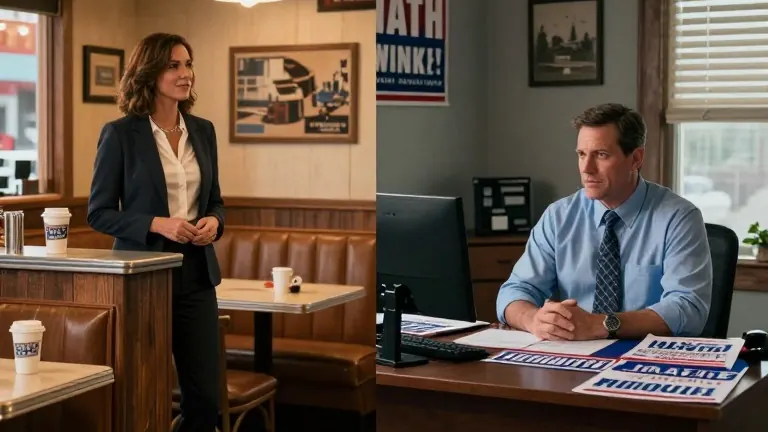
Lisa Kinney, a former state senator, is running as a Democrat in Wyoming, a state that has sent only Republicans to the House since the late 1970s. Her campaign lacks a formal office and relies on a small group of volunteers and extensive road trips to connect with voters. She focuses on preserving public lands and lowering health care costs, aiming to present a moderate alternative to the national Democratic brand.
During a campaign stop in Casper, Kinney engaged with diners at Johnny J's. Some voters rejected her presence, citing issues like immigration enforcement and transgender rights. Joe Beck, an independent voter, acknowledged that he had already voted for her but remained skeptical of her chances. He noted that the state is the reddest in the nation, warning that a political wave is approaching in November. Kinney responded by emphasizing her ability to communicate with both Republicans and Democrats.
Kinney’s husband, Rodney Lang, stated that a victory would strengthen the party infrastructure in the state, even if the candidate does not win the seat. He described the effort as a contribution to the long-term health of the political organization. Kinney called herself a realist who knows many voters will choose the candidate with the Republican label, yet she maintains that a win is possible.
In Connecticut, George Austin, a home builder and former football coach, is running as a Republican in the second congressional district. This area is a Democratic stronghold where the incumbent, Rep. Joe Courtney, has won reelection for 20 years. Democrats have won 45 consecutive U.S. House elections in the state since 2008. Austin aims to restore balance in representation and address congressional gridlock through term limits and guardrails on artificial intelligence.
Austin has invested a quarter of a million dollars of his own money into the campaign. He serves as his own scheduler and volunteer coordinator, reflecting the personal financial toll of running in a difficult district. He noted that voters often disengage when they learn he is a Republican, frequently asking if he supported President Trump before allowing a discussion of specific policy disagreements.
Eric Ostermeier, founder of the nonpartisan site Smart Politics, noted that 19 state delegations currently consist of representatives and senators from the same party. He said this is the highest number in nearly three quarters of a century. Ostermeier attributed this trend to gerrymandering, geographic sorting of voters, and the difficulty state candidates face in separating themselves from national party identities.
In Connecticut, 46 of the 187 state legislature seats are uncontested, a pattern that mirrors national trends where many races are decided before Election Day due to a lack of competitive challengers. Austin described his motivation as a desire to show other working individuals that running for office is worthwhile, even when the odds are low. He acknowledged the difficulty of the path but argued that challenging the status quo is essential for the political process.