Journalist dies in Lebanon strike
A 21-year-old photographer survived being trapped under rubble while her colleague was killed in a village visit during the ceasefire.
By Ivan Mori ·
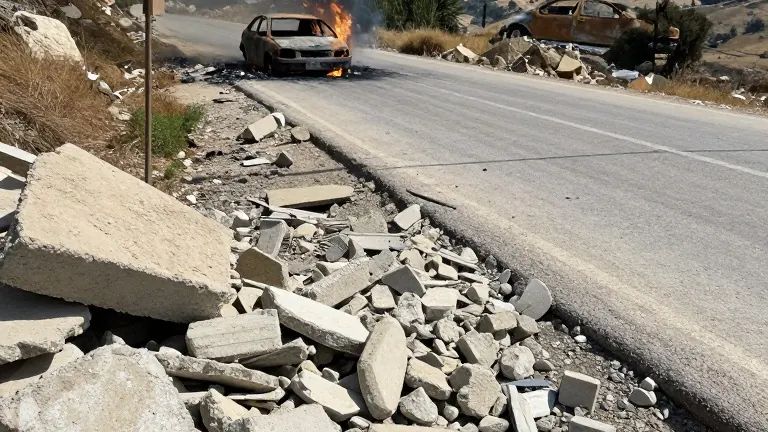
A 21-year-old photojournalist and a 42-year-old newspaper reporter were struck by missiles and drones in southern Lebanon on April 22, 2026. The attack occurred in the village of al-Tiri, less than two months after Israel and Lebanon agreed to a ceasefire. Zeinab Faraj survived the incident, but her colleague, Amal Khalil, died.
Faraj and Khalil traveled to the area to document the damage from a month of airstrikes. They were accompanied by Ali Nabil Bazzi, 27, a municipal official in Bint Jbeil, and Mohammed Hourani, 37, a friend of the mayor. The group had met earlier that day at Tebnine governmental hospital, a location locals considered relatively safe. Bazzi was planning to sign a marriage contract that evening but joined the trip anyway.
Faraj described the initial impact as sudden. She did not hear the incoming missile but heard Khalil scream. The car carrying Bazzi and Hourani caught fire. As the women stepped out of their vehicle, Khalil repeated that the men were gone. Faraj observed that their bodies were torn apart. Drones then descended at low altitude, circling the two women while they made frantic calls to emergency services.
Paramedics on the phone told the journalists to drive back up the road because ambulances could not approach. As they attempted to enter their car, a second missile struck the vehicle. Both women were thrown backward. Khalil, who was bleeding from her face, hand, and leg, wrapped her arms around Faraj. They took shelter in a nearby house, sitting on a bathroom floor. Faraj sent a message to her sister that read, "There’s no hope left. Forgive me," before her phone died.
Faraj was later trapped under rubble after another strike. She recalled hearing a voice and thinking it was her father, but it was a paramedic who had finally reached the site. He held her shoulders while a second paramedic cleared the debris. A stun grenade was dropped by a drone as they were pulled free. Faraj was transported to a hospital in an ambulance, repeatedly mistaking the vehicle's sound for a drone.
Khalil died approximately one hour before paramedics were permitted to return to the area for the second rescue. The Israeli military stated it identified saboteurs violating the ceasefire in its justification for the attack. Human rights groups labeled the incident a war crime. Military officials had shared a video of Khalil published by her newspaper a week prior, describing it as "terrorist media." Khalil had also received death threats from Israeli numbers.
Faraj is now preparing to return to university to finish her degree in radio and TV. She suffers from a limp and visible injuries to her hand and face. She wakes at night screaming and buries herself in pillows when she hears drones. Faraj remains haunted by the image of Hourani lying on the ground with his eyes open after the first missile attack.
The village of al-Tiri is near Bint Jbeil, where Faraj was born and raised. She noted that her whole life revolved around that area. The ceasefire allowed residents to return to their homes or assess what remained of their villages.