
Record tides flood SoCal streets
Water levels in San Pedro broke a 21-year mark Monday, while officials in Newport Beach and Long Beach managed widespread inundation.
By Mateo Thompson ·
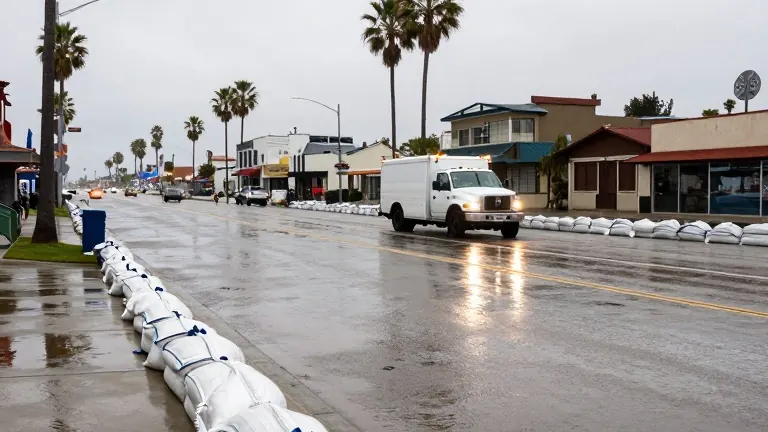
Monday morning brought water onto the streets of Southern California as high tides inundated coastal communities. The surge moved from Newport Beach to Long Beach, flooding low-lying areas and businesses. This event marks the start of a week where near-record or record-high sea levels are expected to persist.
In Newport Harbor, the water surged onto the Balboa Peninsula. The Balboa Fun Zone saw some businesses flood as the tide peaked. Residents in Long Beach reported similar conditions along Bayshore Beach, Naples, and the Peninsula. City crews in both locations had worked over the preceding days to prepare for the surge.
Officials moved sand to shore up beaches and installed sandbags to protect areas that faced damage in recent months. Over the weekend, city leaders urged residents in flood-prone zones to act immediately. This included moving vehicles to higher ground and securing property with barriers.
By Monday, crews in Newport Beach were pumping out knee-high water. They also reinforced sandbags along the harbor side of the Peninsula. Despite the high water, officials stated they had not received reports of major widespread damage. Georgia Rios, a spokesperson for the city of Newport Beach, credited the community for the limited impact.
Rios noted that the city distributed approximately 25,000 sandbags over the weekend. She observed that residents actively participated in the effort to protect their homes. This community response helped prevent a more extensive amount of flooding damage.
The San Pedro tide gauge recorded a new benchmark on Monday morning. The water level reached 8.02 feet, surpassing the previous record of 7.93 feet. That prior high was set in January 2005. Water levels were also exceptionally high in San Diego County.
In La Jolla, officials measured the sea level at 7.75 feet. Chandler Price, a meteorologist with the National Weather Service in San Diego, noted this was close to the station record of 7.81 feet. Price indicated that the record could break given the forecast for higher tides on Tuesday. The current La Jolla record dates to November 25, 2015, during a strong El Niño event.
The National Weather Service issued a coastal flood warning for Orange and San Diego counties. This warning remains in effect through Thursday afternoon. The agency expects significant coastal flooding in these areas. Low-lying property, including homes, businesses, and critical infrastructure, is expected to be inundated.
Farther north, a coastal flood advisory covers Los Angeles, Ventura, Santa Barbara, and San Luis Obispo counties. Isolated damage to structures is possible in the most vulnerable areas. The weather service cited a combination of threats driving the swells. These include an active eastern Pacific hurricane season fueled by El Niño, a marine heat wave, and a rare astronomical alignment.
Total water levels in Los Angeles, Orange, and San Diego counties could exceed 8 feet above the baseline. The baseline is the average daily lowest water level observed between 1983 and 2001. At Los Angeles Harbor, the record is 7.92 feet from January 10, 2005. Projected levels there could hit 8.1 feet on Tuesday and 8 feet on Wednesday.
Newport Beach saw seawater reach 8 feet on Sunday and 8.3 feet on Monday. The Monday level was nearly 2 feet higher than expected from the high tide alone. Potential levels on the city's coastline could reach 8.5 feet on Tuesday at 9:50 a.m. and Wednesday at 10:28 a.m. Scientists attribute the extra height to record-hot ocean temperatures.
These temperatures are causing seawater levels to be 1.25 to 1.8 feet higher than tidal forces alone would produce. Ocean temperatures are influenced by human-caused climate change, an El Niño-fueled Kelvin wave, and a marine heat wave. Surface temperatures at Scripps Pier in La Jolla reached around 77 degrees in early August. The average maximum for that time is about 70 degrees. On Thursday, the temperature was around 73 degrees, well above the 66-degree average for the season.