Washington Arch: Federal Approval Looms Amid Legal Challenges
A 250-foot monument faces a decisive planning vote Thursday as judges weigh emergency motions to halt construction before ground is broken.
By Mateo Thompson ·
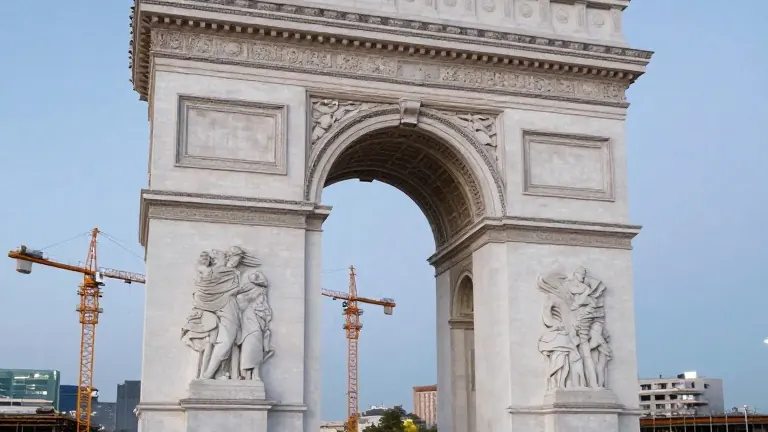
Residents of the Washington, D.C., and Virginia corridor face potential disruptions to traffic, airspace, and historic views if a 250-foot triumphal arch begins construction on Memorial Circle. The National Capital Planning Commission will vote on the project's final approval on Thursday, a decision that could trigger immediate site preparation by a Maryland-based contractor.
The administration is moving to break ground as early as Thursday, pending a final sign-off from the Department of the Interior. This timeline follows a series of accelerated federal reviews. In May, the Commission for Fine Arts approved the initial design, and in September, a federal council ended a historic preservation review that participants had criticized as rushed. The arch would stand more than twice the height of the Lincoln Memorial and feature white concrete topped with three golden statues, including a winged figure holding an eternal flame.
Legal obstacles threaten to delay or stop the project. District Judge Tanya Chutkan is presiding over consolidated lawsuits brought by Vietnam War veterans and an architectural historian, as well as a separate complaint filed by the governments of D.C. and Virginia. The local jurisdictions argue the arch is illegal without specific congressional authorization and would cause "irreplaceable injuries" to local infrastructure and the environment. The veterans, represented by Public Citizen, contend the structure infringes on their rights as future interments at Arlington National Cemetery.
Chutkan has ordered the government to notify the court within one hour of any decision regarding the arch's approval or construction preparation. The administration requested a 24-hour window to accommodate internal communication chains, but the judge maintained the shorter deadline. On Wednesday night, the government informed the court that Grunley Construction Company may be arranging off-site preparations for construction mobilization. The plaintiffs cited a recent case in East Potomac Park, where the government cut down 430 trees with less than a day's notice, to argue for strict judicial oversight.
Aviation safety remains a point of contention. The Federal Aviation Administration stated in September that the arch would not pose a hazard to airspace provided it maintains specific continuous lighting. However, experts note that these unconventional requirements add risks such as glare. In a declaration submitted last week, Defense Secretary Pete Hegseth described the arch as a "generational national defense opportunity," a characterization that emerged days after the President announced the structure would house military equipment. Chutkan questioned how the project would accommodate up to 22,000 daily civilian visitors while serving as a military complex.
The planning commission meeting is expected to last five hours due to high public participation, with nearly 120 individuals registered to speak. The administration has characterized the arch as an iconic global landmark that will enhance the visitor experience at Arlington. The first registered speaker is Michael Lemmon, a veteran and plaintiff in the case, who stated that being interred in the shadow of what he views as a personal vanity project is "profoundly disturbing." The commission's new chair, Mark Paoletta, has publicly expressed enthusiastic support for the design.
The administration estimates construction will take two to three years with crews working 20 hours a day. The first six months will involve underground excavation and foundation work. Opponents argue the project violates federal environmental and historic preservation laws, as well as D.C. height restrictions. The D.C. and Virginia lawsuits claim that excavation will send sediment into the Potomac River and that 320-foot cranes will disrupt complex flight paths. The Trump administration has not sought the congressional authorization its opponents require, instead citing a century-old authorization for a pair of columns that were never built.